
Viktor Ambartsumian: Astrophysicist, Discoverer of Newborn Stars
Foreign visitors kept calling Viktor Ambartsumian a Russian scientist, and he kept correcting them. He was Armenian.
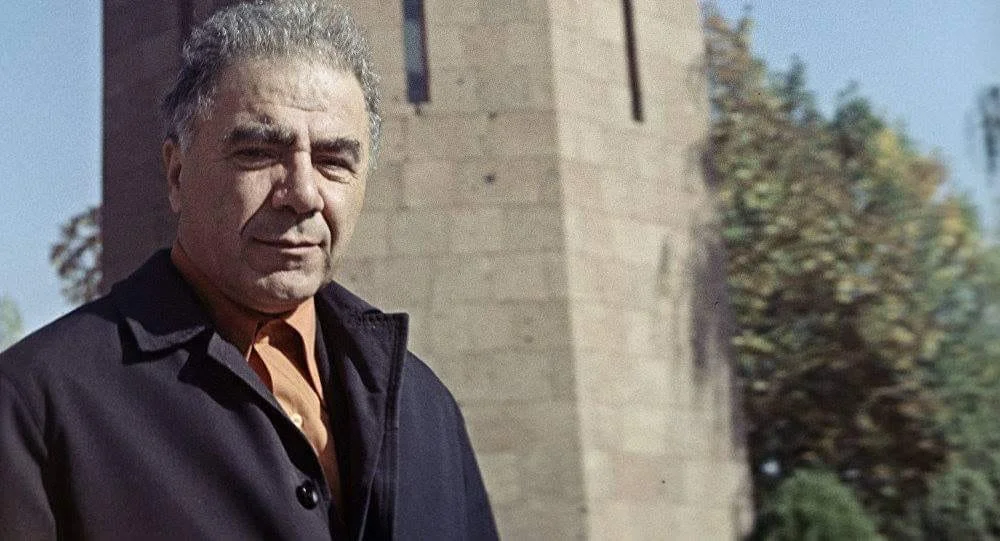
Viktor Ambartsumian at the Ambartsumian Byurakan Astrophysical Observatory
It was an understandable mistake. He was a Soviet citizen, educated in Russian, who rose to the top of Soviet science. But he never let the label stick. He founded the Soviet Union’s first astrophysics department, built an observatory on the slopes of Mount Aragats, and showed the world that stars are still being born in our galaxy, all as an Armenian.
That is what makes him a remarkable Armenian: a boy who could multiply at four and considered himself an astronomer by twelve, and who carried that certainty to the top of 20th-century science without ever giving up who he was.
Early Life and Education
Viktor was born in Tiflis in 1908 to Armenian parents, Hripsime and Hamazasp Hambardzumyan. His father studied law but was also a writer and translator, best known for translating Homer’s Iliad from Classical Greek into Armenian. Viktor grew up learning in both Russian and Armenian, surrounded by a love of language and ideas.
When he arrived at Leningrad State University, admissions had already closed. Rather than wait, he studied physics and mathematics, subjects he loved. Still, he always knew his true profession would be astronomy.
Building a Science From the Ground Up
“As well as being one of the giants of astronomical research in the 20th century, Victor Ambartsumian was also a great leader and organizer of science in Armenia, in Russia, and on the international level.”
British astrophysicist Geoffrey Burbidge
After finishing his postgraduate studies in 1931, Viktor joined the Pulkovo Observatory and taught part-time at Leningrad State University. That same year, he launched the first course in theoretical astrophysics ever offered in the Soviet Union. In 1934, he founded the country’s first department of astrophysics at the university. A year later, he was named professor and awarded the title of Doctor of Physical and Mathematical Sciences without having to defend a thesis. His published work spoke for itself.
From 1939 to 1941, he directed the university’s Astronomical Observatory and served as its deputy president. When the Nazis invaded the Soviet Union, he relocated with fellow faculty to Yelabuga, Tatarstan, where he served as dean until 1944.
Byurakan: Putting Armenia on the Astronomical Map
In 1946, Viktor founded the Byurakan Astrophysical Observatory on the slopes of Mount Aragats. The first buildings were completed in 1951. When he received the Stalin Prize in 1950 for his outstanding scientific work, he used the prize money to build his family home on the observatory grounds.
In 1960, he “secured” a Schmidt telescope, an instrument that captures sharp, wide-field images of the sky. Built by Carl Zeiss in Germany in the 1930s, it had been brought to Leningrad as spoils of war. Under Viktor’s leadership, Byurakan grew into a world-class institution. By 1966, it kept regular contact with 350 research institutions and scientists from 50 countries, and more than 50 scientists earned their doctoral degrees under his guidance. He directed the observatory until 1988, when he was named its honorary director.
Discoveries Ahead of Their Time
In 1947, Viktor discovered stellar associations, loose groupings of roughly 10 to 100 or more visible stars, spread out even more widely than ordinary star clusters. His discovery led to a remarkable conclusion: new stars are still forming in the Milky Way today. The idea was not accepted right away, but scientists later recognized that it had “opened an entirely new field of astrophysical research.”
In the mid-1950s, he turned his attention to the centers of galaxies. He argued that enormous explosions take place in galactic nuclei, hurling vast amounts of matter into space. Once again he was ahead of his peers. The concept of active galactic nuclei became widely accepted years later, especially after the discovery of quasars in 1963.
A Proud Armenian on the World Stage
In 1939, Viktor was elected a corresponding member of the USSR Academy of Sciences and later joined its governing body. He chaired the academy’s commissions on astronomy and cosmogony, the study of how stars, planets, and galaxies form. These roles made him one of the most powerful scientists of his time, and he used that influence to advance science in Soviet Armenia, where he was revered as the nation’s leading scientist.
Whenever foreigners referred to him as a Russian scientist, he corrected them. He was Armenian. Even during the Cold War, he was deeply respected in the United States, becoming the first Soviet scientist named an honorary member of the American Academy of Arts and Sciences and a foreign associate of the National Academy of Sciences.
Science was a family affair. Viktor and his wife, Vera, had four children, all of whom became mathematicians or physicists.
Honors and Legacy
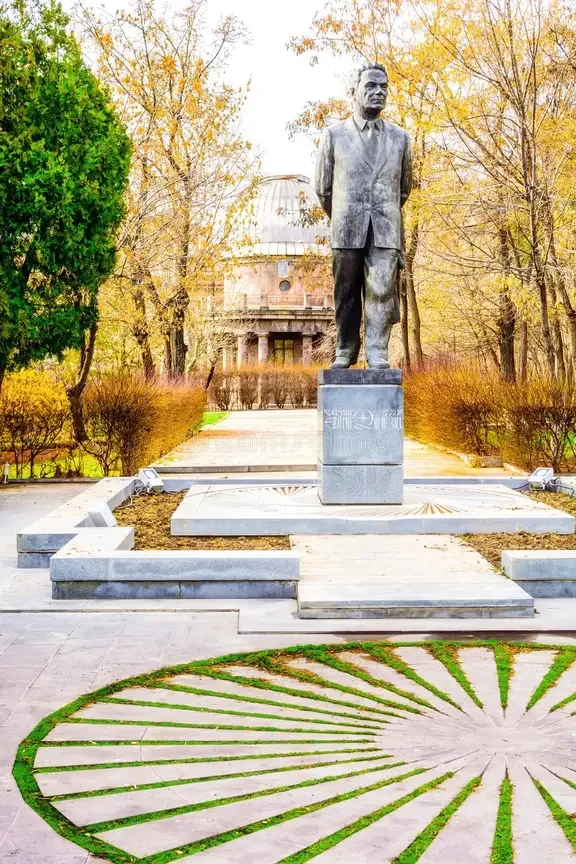
In 2009 a 3.2-meter (10 ft) bronze statue of Ambartsumian was unveiled in Yerevan at the park around the Yerevan Observatory
On October 11, 1994, Armenia’s President, Levon Ter-Petrosyan, awarded Viktor the title of National Hero of Armenia for his scientific work of international significance, his leadership in science, and his patriotic activism.
His name now reaches well beyond Earth. Asteroid 1905 Ambartsumian, discovered at the Crimean Astrophysical Observatory in 1972 by Tamara Smirnova, bears his name, as does Ambartsumian’s Knot, a small tidal dwarf galaxy in NGC 3561 in the constellation Ursa Major. In Armenia, a street, a park, a public school, and the Pedagogical Institute of Vardenis are named in his honor. His portrait appeared on the 100-dram banknote from 1998 to 2004, and in 2009 a bronze statue of him was unveiled in the park around the Yerevan Observatory.
Viktor died on August 12, 1996, at the age of 87, in Byurakan, home of the observatory he had built.
Perhaps British astrophysicist Geoffrey Burbidge said it best:
“As well as being one of the giants of astronomical research in the 20th century, Victor Ambartsumian was also a great leader and organizer of science in Armenia, in Russia, and on the international level.”